The Kohl Chancellorship by Clay Clemens & William E. Paterson
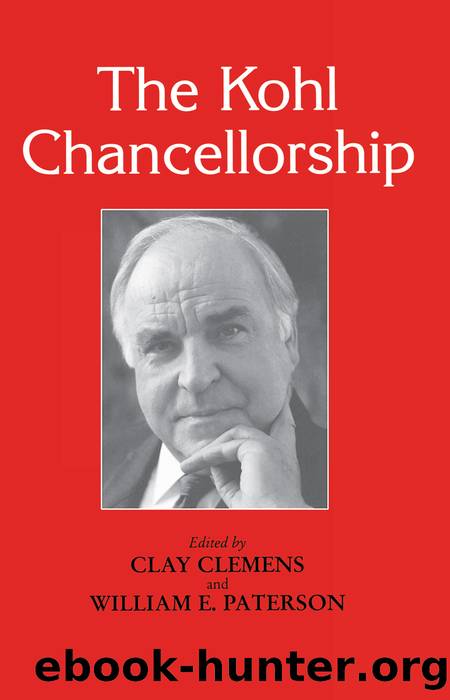
Author:Clay Clemens & William E. Paterson [Clemens, Clay & Paterson, William E.]
Language: eng
Format: epub
Tags: Political Science, General
ISBN: 9780714644417
Google: b3iXQgAACAAJ
Goodreads: 5601851
Publisher: F. Cass
Published: 1998-01-15T10:32:17+00:00
A Monopoly on Information: The Early Warning System as an Aspect of Political Management
Kohl developed certain procedures which enabled him to find out about and assess important attitudes and interests within his party without having to engage in a public debate. This necessitated an intricate network of informers from all levels of the party. They in fact constituted the chancellorâs âearly warning systemâ, and the information they supplied was a decision-making source that he set along with that supplied by the civil service. It enabled him to form his own picture of any given situation. Keeping in touch with the rank and file in this way formed part of his overall system. He had to do so in order to stay in power, though it was very time-consuming and needed constant attention. If there were signs of internal opposition within the party, or, less dramatically, a need for urgent political regulation and action, he himself attempted to integrate his opponents, or ordered his negotiators to work out a compromise. At any rate, every alarming report received via the early warning system indicated how a routine matter could become potentially dangerous in political terms. On the other hand, this early warning system at times failed to function. It was certainly not perfect, especially when it came to analysing what was happening in the GDR.
As we have seen, action taken on Deutschlandpolitik certainly reflected more general criteria for governance, such as defining the overall thrust, organising the action to be taken, and possessing the ability to implement policies previously agreed on. Thus Deutschlandpolitik and the âKohl Systemâ were at one and the same time determined by current events, dependent on specific structures, and shaped by personal involvement. It amounted to mastering and simultaneously managing a situation. Deutschlandpolitik during Kohlâs chancellorship cannot be explained exclusively by issue politics or power politics. As the examples of this study show, the importance of this policy area for him varied. In some cases it played an important role for his power-base, but in other cases it was irrelevant.33 However, at the same time, the aim of German unification had more than merely tactical meaning for Kohl. Rather, as analysis of his chancellorship indicates, he wanted German unification during the 1980s, but did not see any chance of realising it â until 1989.
Download
This site does not store any files on its server. We only index and link to content provided by other sites. Please contact the content providers to delete copyright contents if any and email us, we'll remove relevant links or contents immediately.
| Anthropology | Archaeology |
| Philosophy | Politics & Government |
| Social Sciences | Sociology |
| Women's Studies |
The Secret History by Donna Tartt(19088)
The Social Justice Warrior Handbook by Lisa De Pasquale(12190)
Thirteen Reasons Why by Jay Asher(8910)
This Is How You Lose Her by Junot Diaz(6887)
Weapons of Math Destruction by Cathy O'Neil(6280)
Zero to One by Peter Thiel(5802)
Beartown by Fredrik Backman(5754)
The Myth of the Strong Leader by Archie Brown(5508)
The Fire Next Time by James Baldwin(5446)
How Democracies Die by Steven Levitsky & Daniel Ziblatt(5219)
Promise Me, Dad by Joe Biden(5153)
Stone's Rules by Roger Stone(5088)
A Higher Loyalty: Truth, Lies, and Leadership by James Comey(4964)
100 Deadly Skills by Clint Emerson(4925)
Rise and Kill First by Ronen Bergman(4789)
Secrecy World by Jake Bernstein(4753)
The David Icke Guide to the Global Conspiracy (and how to end it) by David Icke(4720)
The Farm by Tom Rob Smith(4513)
The Doomsday Machine by Daniel Ellsberg(4490)
